
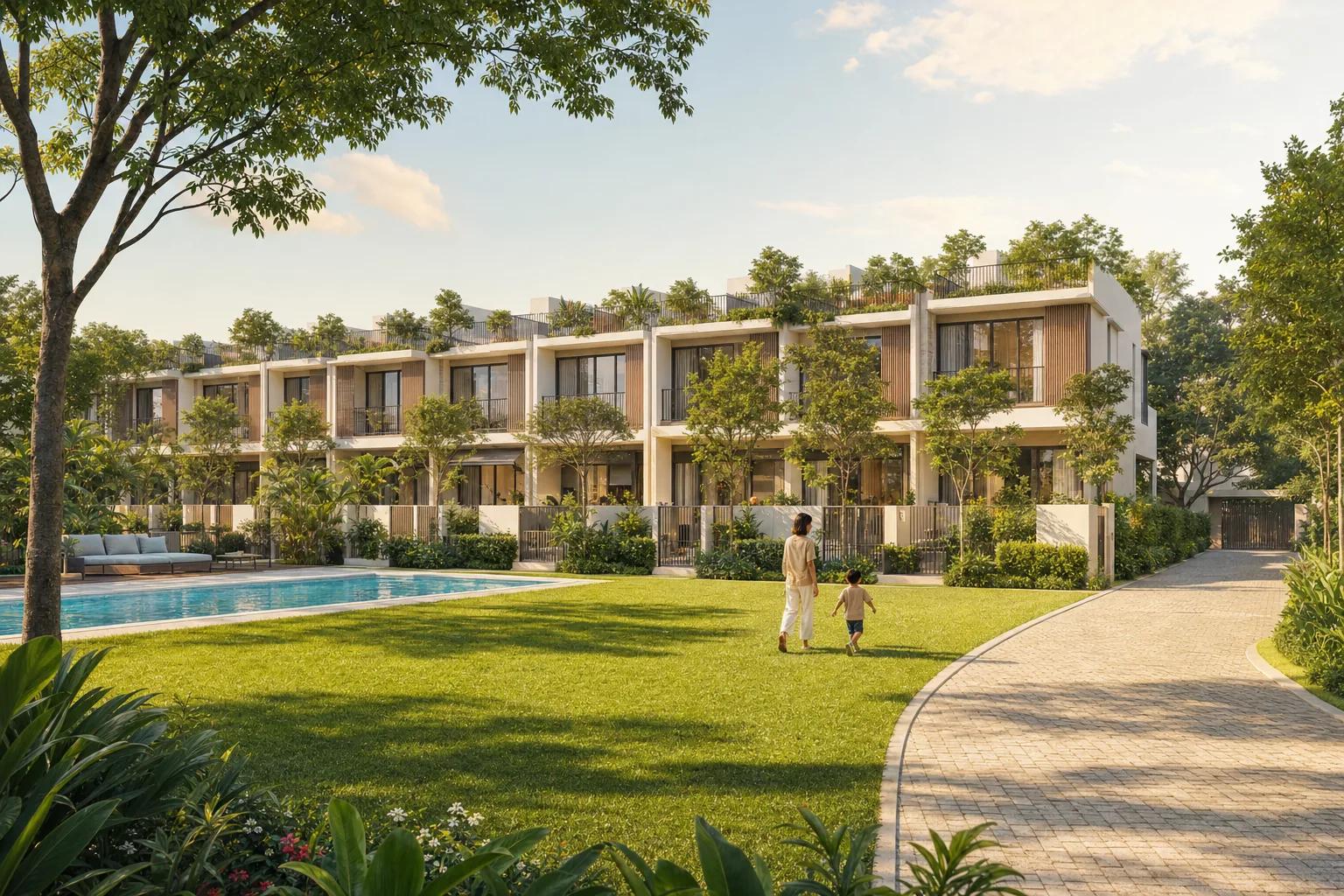
A cluster house in Singapore is a landed home, a terrace, semi-detached house or bungalow, that you own on strata title inside a shared development rather than on its own plot. "Cluster house" is the everyday name; the Urban Redevelopment Authority's (URA) planning rules cover these homes as strata landed housing: strata-titled houses "occupying a common development site with shared communal facilities and a single vehicular access point".
So a buyer gets a management corporation (MCST) whose consent some works need, a driveway and facilities shared with neighbours, tighter limits on extensions, and price-per-square-foot figures that cannot be compared with a terrace down the road. General information, not financial or legal advice.
What is a cluster house in Singapore?
URA's strata landed housing handbook (last updated 6 November 2026) allows strata bungalows, strata semi-detached houses and strata terraces (a row of at least three), alone or mixed on one site. Each house needs at least 50 square metres of ground contact. Two details are easy to miss:
- Hybrids are different. Strata landed houses may be allowed within a flats development, but URA says such hybrids "are not accorded condominium status" and are not allowed in designated landed housing areas.
- The estate decides the form. In safeguarded landed housing estates, URA's locational criteria allow strata terraces only in mixed landed housing areas, strata semi-detached houses in semi-detached and mixed areas, and strata bungalows in bungalow areas (including Good Class Bungalow Areas, or GCBAs), semi-detached and mixed areas.
In URA's market statistics a cluster house counts as landed: its property market glossary (last updated 17 June 2026) defines landed property as detached, semi-detached and terrace houses, townhouses, strata bungalows and cluster housing.
Cluster house or land-titled house: what changes
- What you own: a strata unit within a common site, not a house on its own plot. URA's renovation pages split owners the same way, into land-titled and strata-titled homes, the second covering flats, condominiums and strata landed units.
- Getting the car home: under URA's access rules, vehicles reach each house only from the common driveway, never directly from a public road.
- Shared ground: URA's site coverage rules require at least 45% of the nett site area as communal open space, with at least 25% of the site area as on-ground greenery, none of it inside an owner's plot.
How many homes can a cluster development hold?
URA caps the unit count with a formula on its number of units page (last updated 7 June 2026): within a GCBA, 35% of the site area divided by 500 square metres (a typical Good Class Bungalow footprint); outside one, 40% of the site area divided by 200 square metres for other bungalows or 100 for terrace and semi-detached houses, rounded down to a whole number. A site mixing house forms uses a combined version of the same cap, and URA may set a stricter one in areas of concern. On an illustrative 10,000 square metre site (the site is fictional; the formula is URA's):
- Strata terraces or semi-detached houses outside a GCBA: 40% of 10,000 divided by 100 gives at most 40 houses.
- Strata bungalows outside a GCBA: 40% of 10,000 divided by 200 gives at most 20 houses.
- Strata bungalows within a GCBA: 35% of 10,000 divided by 500 gives at most 7 houses.
The same site would keep at least 4,500 square metres as communal open space (if none is set aside for road or drain reserves), and site coverage is capped at 50% outside a GCBA and 45% within one. The unit count tells you how many households share the driveway, pool, gardens and upkeep; ask for it with the budgeted maintenance charges. Our condo maintenance budget guide shows how to plan for them.
What are the private enclosed space and roof terrace?
A private enclosed space (PES) is a semi-outdoor area next to the house, and a private roof terrace (PRT) is one at roof level. URA's PES and PRT guidelines (last updated 6 July 2026) say both are part of the private strata area sold to the owner, and in strata landed developments submitted on or after 1 June 2023 they also count as gross floor area (GFA).
- The developer must install a cover at least 2 metres wide from the external wall. Beyond that, an owner may extend it only with a design approved upfront and with MCST clearance.
- PES fencing may be no higher than 1.3 metres; a 1.8 metre screen wall may separate neighbouring spaces.
- A roof terrace cover is optional, again from approved designs and with MCST clearance.
Our floor plan guide shows how to separate these spaces from the internal area.
Can you renovate or extend a cluster house?
URA's strata-titled renovation page (last updated 12 June 2026) says internal works need no planning permission if they add no GFA and the house stays one self-contained home. Open-sided covers over the PES or roof terrace need no URA permission either, but do need MCST consent and must meet Building and Construction Authority (BCA) and fire safety requirements where they apply.
Adding floor area is where a cluster house differs most: the planning application needs a letter from the management corporation confirming that a 90% resolution of the MCST authorised the works. A land-titled owner may enlarge or move rooms without planning permission, and URA's Landed Housing e-Advisor states that it does not apply to strata landed housing. If you are buying with an extension in mind, treat it as uncertain until your neighbours agree; our guide to what URA lets you change after the showflat covers the strata rules.
Why does a cluster house look cheaper per square foot?
Because URA measures it differently. Its glossary says the median price per square foot for detached, semi-detached and terrace houses is calculated on land area, but for cluster housing and townhouses on strata floor area.
An illustrative comparison, using the price in the Inland Revenue Authority of Singapore's (IRAS) own stamp duty example, S$4,500,100 (the areas are fictional):
- A terrace house on 1,800 square feet of land works out at about S$2,500 psf on land area.
- A cluster house at the same price with 3,600 square feet of strata area, PES and roof terrace included, works out at about S$1,250 psf on strata area.
Neither is cheaper. Compare cluster houses with cluster houses, strata area against strata area, using URA's caveat search, and convert a plan's square metres with our sqm to sqft converter.
Stamp duty does not depend on the title. IRAS sets different Buyer's Stamp Duty rates for residential and non-residential property, and a cluster house is a home, so the usual residential rates apply: IRAS's example terrace at S$4,500,100 pays S$209,606, and a cluster house at the same price would pay the same. Additional Buyer's Stamp Duty depends on your profile; our BSD and ABSD calculator works out both.
Can foreigners buy a cluster house?
Not freely. URA's buying property page (last updated 6 November 2026) says anyone who is not a Singapore citizen must get approval from the Controller of Residential Property at the Singapore Land Authority (SLA) "before you can buy landed houses including but not limited to strata landed houses". SLA's own pages could not be opened today, so a permanent resident or foreigner should check with SLA before paying anything. Our guide for foreign buyers covers the wider rules.
What to check before booking a strata landed unit
- Form and development type: terrace, semi-detached or bungalow, in a pure strata landed development or a hybrid within a flats development.
- Strata area breakdown: internal area, PES, roof terrace and any private parking lots, each stated separately.
- Approved cover designs for the PES and roof terrace.
- How many houses share the driveway and facilities, and the budgeted maintenance charges.
- Tenure: freehold or 99-year; our freehold versus leasehold guide explains how the remaining lease affects CPF use.
- Approved plans: URA's buying page advises getting them to rule out unauthorised works.
- Financing: CPF Board's guidance on using CPF to buy property lists bank loans of up to 75% of the purchase price, subject to terms and conditions, and suggests keeping your total debt servicing ratio within 55% of gross monthly income; test yours with our mortgage calculator.
More side-by-side guides are on the comparisons topic page.
Common questions
What is the difference between a cluster house and a terrace house?
A terrace house stands on its own land title, while a cluster house is a strata-titled house in a shared development with a common driveway and communal facilities, run by an MCST.
Is a cluster house considered landed property in Singapore?
Yes, URA's property statistics count cluster housing as landed property, although the house is held on strata title.
Can I extend my cluster house?
Works that add floor area need a planning application with a letter confirming a 90% resolution of the MCST; internal works that add none need no planning permission.
Can a permanent resident buy a cluster house?
URA says anyone who is not a Singapore citizen needs SLA's approval before buying landed houses, including strata landed houses, so check with SLA first.
Sources
- strata landed housing handbook ura.gov.sg
- locational criteria ura.gov.sg
- property market glossary ura.gov.sg
- land-titled ura.gov.sg
- strata-titled ura.gov.sg
- access rules ura.gov.sg
- site coverage rules ura.gov.sg
- number of units page ura.gov.sg
- PES and PRT guidelines ura.gov.sg
- Landed Housing e-Advisor ura.gov.sg
- residential rates iras.gov.sg
- buying property page ura.gov.sg
- guidance on using CPF to buy property cpf.gov.sg
Something changed or worth adding?
Send a correction or suggestion
