
The Jurong Region Line (JRL) is Singapore's seventh MRT line: a fully elevated, 24 km line with 25 stations in the west, running from Choa Chu Kang and Tengah to Boon Lay, Jurong East and Pandan Reservoir, and towards NTU and Jurong Pier. It is not open yet. In a factsheet of 4 March 2026, the Land Transport Authority (LTA) said Stage 1, from Choa Chu Kang to Boon Lay and Tawas, will open around mid-2028 instead of end-2027, and that it will give further updates on the opening dates of Stages 2 and 3. For anyone weighing a new home in the west, the useful question is not "is there a station nearby?" but "which stage is that station in, and what has LTA actually said about its date?"
Below: what LTA's pages say as of 22 November 2026, what is still open, and how to test a "near the upcoming JRL" claim. General information from desk research, not financial, legal or property advice.
At a glance
- The line: 24 km, fully elevated, 25 stations, with interchanges at Choa Chu Kang, Boon Lay and Jurong East (LTA project page).
- Stage 1, around mid-2028: 10 stations, Choa Chu Kang to Boon Lay and Tawas, six months later than the earlier end-2027 target (LTA, 4 March 2026).
- Stage 2: 7 stations from Tengah to Pandan Reservoir via Jurong East; listed under 2028 on LTA's project page.
- Stage 3: 7 stations into NTU and towards Jurong Pier; listed under 2029 on LTA's project page.
- Updates pending: LTA said in March 2026 it will give further updates on the Stage 2 and Stage 3 opening dates as works progress.
- Before the trains: interim JRL shuttle buses from the second half of 2027, broadly following the line (LTA, 20 September 2026).
- Later additions: an in-fill station, JS2A, in Tengah in the mid-2030s, and engineering studies for a West Coast Extension.
What is the Jurong Region Line, and where does it run?
LTA's Jurong Region Line project page describes it as a line serving existing and future development in the west, linking key activity nodes such as the Jurong Industrial Estate, the Jurong Innovation District and Nanyang Technological University (NTU), areas LTA says are not currently served by an MRT line. LTA says the line will put more than 60,000 additional households in Jurong within a 10-minute walk of a train station.
LTA lists 62 driverless three-car trains, expandable to four cars. The three interchanges connect it to the existing network: Choa Chu Kang (North-South Line and Bukit Panjang LRT), Boon Lay (East-West Line) and Jurong East (North-South and East-West Lines).
In the text of LTA's project page, only the three interchanges are named as stations; every other station appears by its code, such as JS3 or JE2, and the stage headings name places (Tawas, Tengah, Pandan Reservoir, NTU, Jurong Pier) rather than stations. If a brochure gives a station a name, match it to a code and a stage on LTA's page before relying on it.
When does each stage open?
Here is what LTA's own pages say today, stage by stage.
- Stage 1, around mid-2028. Choa Chu Kang to Boon Lay and Tawas: 10 stations, JS1 to JS8 (excluding JS2A) and JW1 to JW2. The March 2026 factsheet gives "around mid-2028"; the project page lists the stage under 2028.
- Stage 2, listed under 2028. Tengah to Pandan Reservoir on the JRL (East): 7 stations, JE1 to JE7, with Jurong East as the interchange.
- Stage 3, listed under 2029. Into NTU and towards Jurong Pier: 7 stations, JS9 to JS12 and JW3 to JW5.
- JS2A, mid-2030s. An in-fill station between JS2 and JS3 for future demand in Tengah; LTA says civil works are underway and it will open "in tandem with the completion of future developments surrounding the station".
The two pages do not say the same thing about Stages 2 and 3. The project page, which already shows JS2A and the 25-station total from the March factsheet, lists Stage 2 under 2028 and Stage 3 under 2029 and gives 2029 as the line's expected completion. The March factsheet gives no new date for either stage and says only that LTA "will provide further updates on the opening dates of the second and third stages of the JRL as works progress". Neither page gives a month. Our reading: treat 2028 and 2029 as the latest published targets for those stages, open to the update LTA has promised.
Further out, the factsheet says engineering studies for a West Coast Extension, first from JE7 to a station with the working name CR18 West Coast, were planned to begin in 2026; no opening date is given. For the Cross Island Line, including its Phase 2 to the Jurong Lake District, see our Cross Island Line guide.
Why did Stage 1 move to mid-2028?
LTA's factsheet says it could not recover all the earlier COVID-19 delays, even with more manpower and equipment, because some complex works needed more time to complete safely. It gives two examples: viaduct works over the Pan-Island Expressway could be carried out only during overnight road closures on designated nights, and a viaduct over a 25-metre wide canal needed more comprehensive ground reinforcement than originally planned. It also says works take place "next to live roads and residential developments", which matters if you are looking at a home beside the alignment.
What happens before the trains run?
LTA's release of 20 September 2026 says interim JRL shuttle buses will start from the second half of 2027, before Stage 1 opens. They will "broadly follow the JRL route" and connect commuters to key station locations, with fewer stops for shorter journeys. LTA says details will be shared closer to the start date, so no route, stop or frequency is published yet.
The March factsheet had said "end-2027" for these buses and linked them to the areas Stage 1 will serve; the September release says "from the second half of 2027", a wider window that does not by itself mean an earlier start. Go by the later release, and note that neither release says whether the buses reach Stage 2 or Stage 3 station areas.
How should the JRL change the questions you ask about a home?
What follows is our reading of LTA's pages, not an agency's statement.
- Find the station code, then the stage. "Near an upcoming JRL station" means around mid-2028 for a Stage 1 station, but for a Stage 3 one a year (2029 on the project page) that LTA has said it will update.
- Keep the date with its source. Note where and when any opening year was published in your new launch research file.
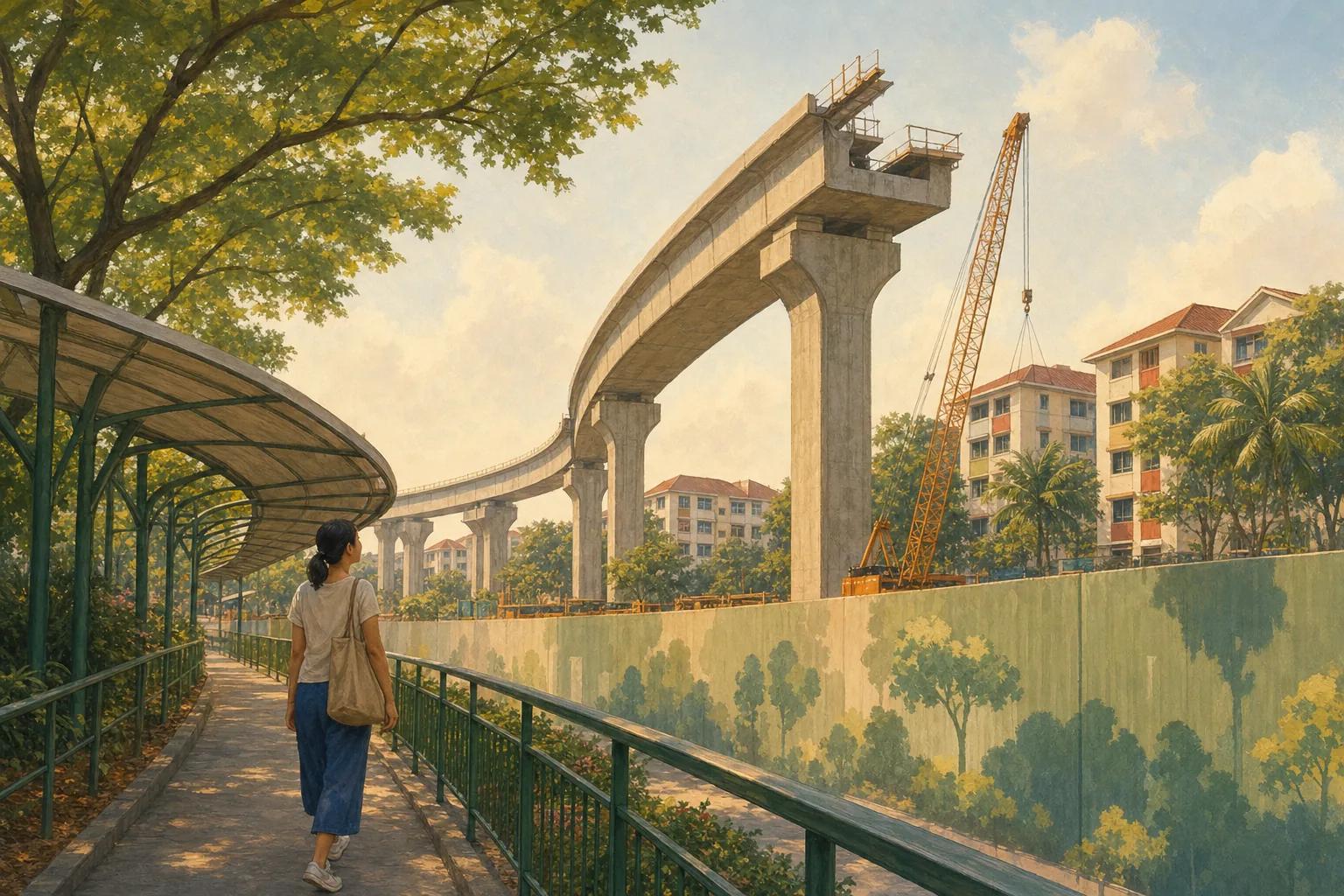
- The line is elevated. A home facing the alignment may look onto a viaduct and hear trains; a neighbourhood walk and the site plan show this, a showflat does not.
- "Within a 10-minute walk" is a line-level figure. LTA's 60,000-household number describes the whole line, not a particular block. Time the walk from the actual block to the station location, as our commute test explains.
- Get transport claims in writing, with source and date, as our guide to checking new-launch marketing claims sets out.
- Check what else is planned nearby. URA's Master Plan amendments can change the land between a home and a station; our Master Plan 2025 amendments guide shows how to look.
Worked example: the gap between keys and trains
An invented example; the homes, dates and household are made up. A household compares two fictional new launches in the west.
- Home A is beside a Stage 1 station. The developer's expected Temporary Occupation Permit (TOP) date is December 2027; our TOP guide explains what that permit sets off.
- Home B is beside a Stage 3 station, with an expected TOP of June 2028.
- Home A: LTA's target is "around mid-2028". If that means June or July 2028 (our reading of "mid"), the household lives there for about 6 to 7 months before the train runs, with interim shuttle buses due to start in the second half of 2027 in the meantime.
- Home B: LTA's project page lists Stage 3 under 2029 with no month. If that holds, the gap is 7 months (to January 2029) at the earliest and 18 months (to December 2029) at the latest. LTA has said it will update this stage's date, so the gap could change either way.
- TOP dates are expectations too. A later TOP shortens the gap; a later station lengthens it.
Neither home is the better buy on this alone; price each on the journeys possible on moving-in day, and treat the station as a dated future improvement.
A checklist before you book in the west
- Note which stage the nearest station code is in on LTA's Jurong Region Line page.
- Measure the walk from the actual block to the station location, not from the development's gate.
- Check which units face the viaduct, and visit at the time of day you would commute.
- Plan today's journeys on existing MRT and bus routes; the shuttle bus routes are not yet published.
- Save each page with its date, and recheck when LTA updates the stage dates.
For other dated changes in the west, see our guides to the Town Hall Link tender in the Jurong Lake District and the Tengah hospital plans. More planning explainers sit under Start your research.
Common questions
When will the Jurong Region Line open?
In stages: LTA says Stage 1, from Choa Chu Kang to Boon Lay and Tawas, will open around mid-2028; its project page lists Stage 2 under 2028 and Stage 3 under 2029, and LTA has said it will give further updates on those two dates.
Why was the Jurong Region Line delayed?
LTA says it could not recover all the earlier COVID-19 delays because some complex works needed more time; its examples are viaduct works over the PIE, possible only during overnight road closures, and a viaduct over a 25-metre wide canal that needed more ground reinforcement than planned.
Is there transport before the JRL opens?
LTA plans interim JRL shuttle buses from the second half of 2027 that broadly follow the line's route with fewer stops; routes and stops will be announced closer to the start.
What are the Jurong Region Line's interchange stations?
Choa Chu Kang (North-South Line and Bukit Panjang LRT), Boon Lay (East-West Line) and Jurong East (North-South and East-West Lines); the text of LTA's project page lists the other stations by code.
Sources
- factsheet of 4 March 2026 lta.gov.sg
- Jurong Region Line project page lta.gov.sg
- release of 20 September 2026 lta.gov.sg
Something changed or worth adding?
Send a correction or suggestion

